Marks vs. Prices, Technology and the capital cycle
A fund up 439% was margin called four trading days after its investor letter
By Jeff Baehr, Founder & CEO, Praxis Rock Advisors
In brief
Situational Awareness reported 439% net for the first half, and four trading days later its prime brokers were selling the borrowed slice of its stock book. Its private stakes, which no lender could margin call, came through intact. The financing broke, not the forecast.
The most-watched fund in AI was up 439% net through June. Citadel just bought its stock book.
That's not an AI story. It's a duration story.
Leopold Aschenbrenner published his AGI essay in June 2024, launched Situational Awareness that fall, and ran it to $45 billion by the start of July, per CNBC. On July 24 he sent investors a letter, reviewed by the Financial Times, reporting 439% net for the first half and inviting new capital from August 1. He called the selloff the most compelling opportunity set since early 2025.
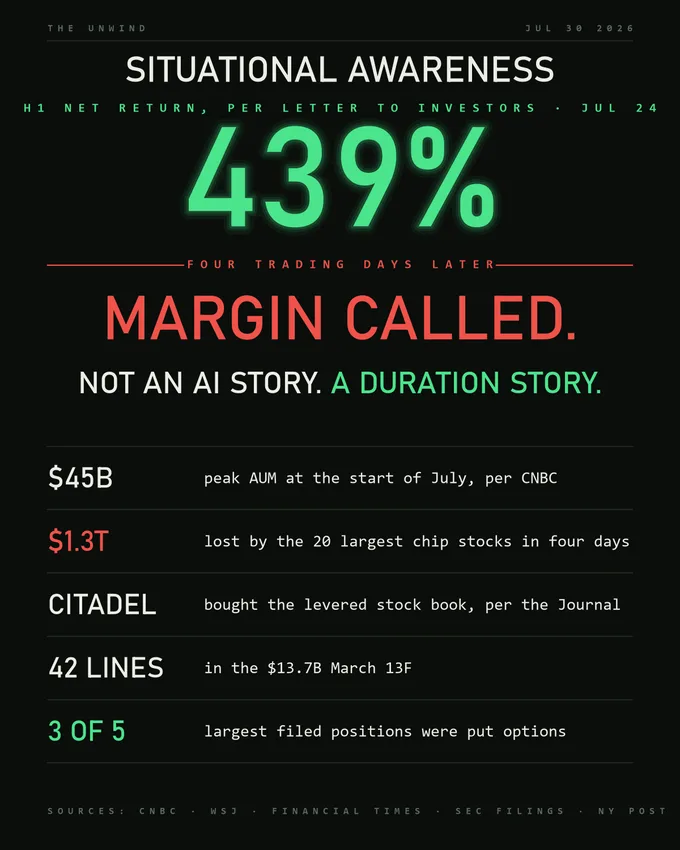
Source: see Sources below. As of July 2026.
| Figure | What it shows |
|---|---|
| 439% | First-half net return, per the July 24 letter to investors |
| $45BN | Peak assets at the start of July |
| $1.3TN | Value lost by the 20 largest chip stocks over four trading days |
| 42 | Lines in the $13.7BN March 13F |
| 3 of 5 | Largest filed positions that were put options |
Four trading days later his prime brokers were shopping the book. CNBC counts $1.3 trillion of value lost across the 20 largest chip stocks in that window. The fund's long SK Hynix position and a short against Adobe moved against it at the same time, borrowed money did the rest, and Bank of America, Goldman, and JPMorgan worked the margin calls. Citadel bought exactly the slice the borrowing financed, per the Journal; the firm kept what client capital funded. Millennium bid too.
Investors tracked this fund's filings; a retail platform even built a feature to mirror them, and T1 Energy jumped 23% in a day when his stake appeared, per the New York Post. But the most recent 13F, from March, shows $13.7 billion across 42 reported lines, and neither name CNBC points to is in it. SK Hynix trades in Seoul. Short stock doesn't file. Three of the five largest positions were put options. The most-copied portfolio in AI blew up on trades nobody copying it could see.
And the sleeve that survived is the one that can't trade. Situational kept its private stakes, including Anthropic, per the Journal. The sale hit before Thursday's open; by early afternoon the names he was forced out of were up 16 to 27%. The private book is intact, not because it's worth more, but because nobody can margin-call a mark that doesn't move.
The industry line is that illiquidity is the risk you get paid to bear. This week it was the survival mechanism.
Four investment professionals ran this book, per the firm's own ADV. The leverage was a choice, not a condition. The thesis may still prove out. What broke was the financing, not the forecast. If your conviction runs a decade and your capital reprices overnight, the thesis isn't yours. It's your prime broker's.
The research behind this
- CNBC, Leopold Aschenbrenner's hedge fund is facing steep losses, July 30, 2026.
- The Wall Street Journal, Citadel buys Situational Awareness's stock portfolio after big losses, July 30, 2026.
- Financial Times, Report on the July 24 investor letter, July 2026.
- SEC EDGAR, Form 13F filings, CIK 2045724, May 18, 2026.
- SEC Investment Adviser Public Disclosure, Form ADV, CRD 333011, 2026.