Marks vs. Prices, Private credit and lending
Private credit's low correlation was partly a marking effect, and the shock found the daily price
By Jeff Baehr, Founder & CEO, Praxis Rock Advisors
In brief
From their 2025 highs to early 2026, shares of five listed managers fell 41% to 67%. Withdrawal requests at three semi-liquid credit funds ran 7.9% to 13.9% in one quarter, and the preset caps became the gates. Redemption queues, not marks, are where the stress now shows.
Private credit wasn't uncorrelated. It was unmarked.
For a decade the pitch was low correlation to public markets. Steady NAVs through every drawdown looked like proof. Then a real credit shock arrived, and the exposure repriced through the one window that trades daily.
From their 2025 highs to early 2026: Apollo down 41%, Blackstone 46%, Ares 48%, KKR 48%, Blue Owl 67%. Fortune's tally puts the combined damage above $265 billion of market value.
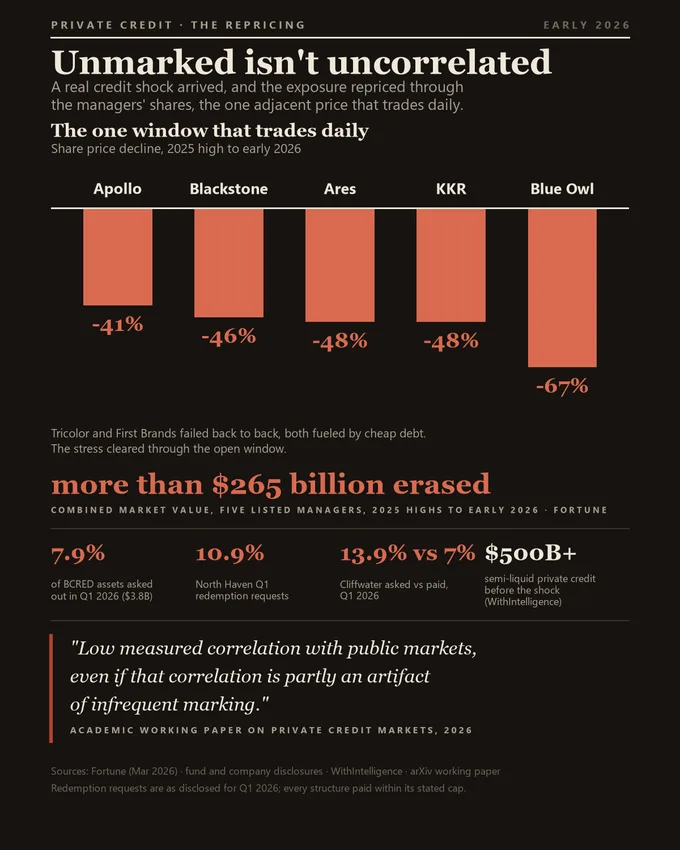
Source: see Sources below. As of July 2026.
| Figure | What it shows |
|---|---|
| 41% to 67% | Share price declines of five listed managers, 2025 highs to early 2026 |
| $265BN+ | Combined market value erased |
| 7.9% | BCRED assets asked out, first quarter of 2026 ($3.8BN) |
| 10.9% | North Haven redemption requests, first quarter of 2026 |
| 13.9% vs 7% | Cliffwater flagship, asked versus paid |
| $500BN+ | Semi-liquid private credit before the shock |
The cracks showed first in credit. Tricolor and First Brands failed back to back, both fueled by cheap debt. The managers' shares carry fee beta, not loan marks. But they are the one adjacent price that trades daily, and the stress cleared through the open window.
An academic working paper on private credit markets says the quiet part in one line: the low measured correlation with public markets is partly an artifact of infrequent marking. The volatility was never absent. It was deferred, and it accrued to whoever held the one instrument that could not defer it.
The retail wrappers transmitted the shock instead of containing it. Blackstone's BCRED took $3.8 billion of withdrawal requests in the first quarter, 7.9% of assets. Morgan Stanley's North Haven ran 10.9%. At Cliffwater's flagship, requests hit 13.9% in that one quarter; the fund repurchased the 7% its terms allow. Every structure worked as designed, which is the uncomfortable part: the pre-set caps became the gates. Caps built for orderly quarters met a correlated ask. And the wrappers had scaled first: semi-liquid private credit was already past $500 billion before the shock, per WithIntelligence.
There is an honest defense, and some managers own it: senior paper, real covenants, losses priced at origination, redemption terms matched to the assets. Lenders who marked honestly this cycle get to prove it now, and the proof will be a redemption queue that clears. Accruers who let the wrapper do the smoothing are about to explain the difference in public.
Queues measure investors, not loans. But the wrapper only works if investors do not all want out at once, and that assumption was the correlation pitch in different clothes.
My sense is the next four quarters of redemption queues become the disclosure the marks never were.
If the correlation was real, why did one credit shock fill the queues?
The research behind this
- Fortune via Yahoo Finance, The $265 billion private credit meltdown, March 2026.
- arXiv, Working paper on private credit markets (2603.14491), March 2026.