Marks vs. Prices, Technology and the capital cycle
Nvidia's $500BN financing plan is credit backed by the seller's own number
By Jeff Baehr, Founder & CEO, Praxis Rock Advisors
In brief
Six institutions signed memorandums of understanding to mobilize over $500BN of third party capital, lent to Nvidia's customers to buy Nvidia chips. The collateral is the residual value of used GPUs, and the seller stands behind that value. How far lenders haircut it is the trade.
Nobody handed Nvidia $500 billion. Something more interesting happened.
The headline version of Monday's announcement was Wall Street's half-trillion-dollar vote of confidence in AI. Read the release instead.
Six institutions signed memorandums of understanding, "subject to execution of the final agreements." The money is not committed, and it is not Nvidia's. The platforms exist "to mobilize over $500 billion of third-party capital," in "dedicated pools of capital at significant scale at attractive rates for NVIDIA customers."
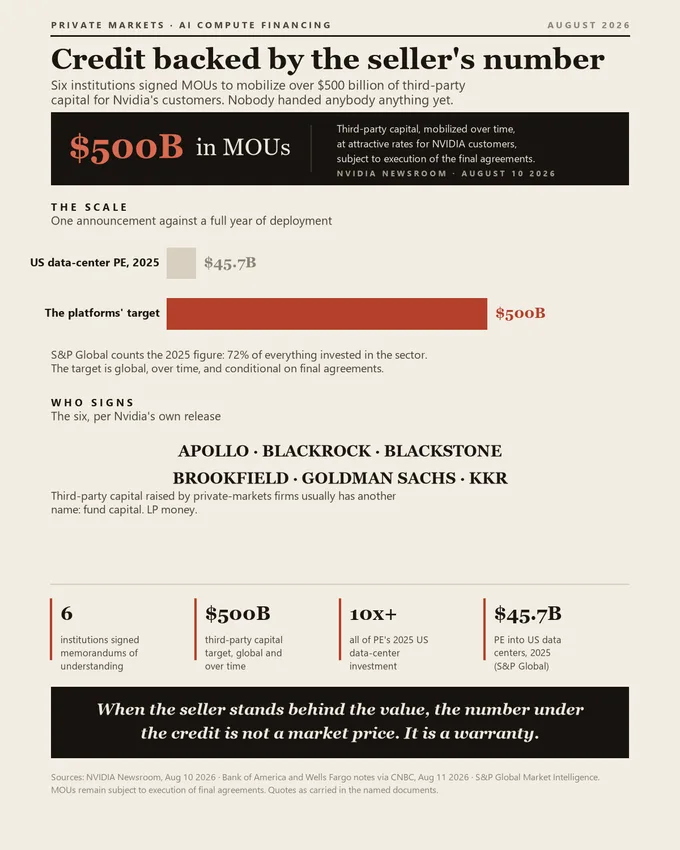
Source: see Sources below. As of August 2026.
| Figure | What it shows |
|---|---|
| 6 | Institutions that signed memorandums of understanding |
| $500BN | Third party capital target, global and over time |
| $45.7BN | Private equity money into US data centers, 2025 |
| 10x+ | The target against that 2025 figure |
Follow each clause. Other people's money. Lent at attractive rates. To Nvidia's buyers. To buy Nvidia chips. Aircraft finance reads the same. The difference is the collateral.
There is a name for a seller arranging financing for its own customers, and Bank of America's note reached for it to rule it out: "a pivot away from vendor-financing," the burden now sitting "with the consortium," not Nvidia's balance sheet. The pivot is real. In the old version the vendor carried the risk. In this one the risk moves to the third-party capital. Most of it.
Look at who the six are. Apollo, Blackstone, Brookfield, KKR, alongside BlackRock and Goldman Sachs. Third-party capital raised by private-markets firms usually has another name: fund capital. LP money.
Goldman's CEO named the collateral: a new "market for credit backed by NVIDIA compute."
Every credit structure has a load-bearing number. Contracts aside, here it is the residual value of a used GPU. Jensen Huang's case is that chips are "long-lived" and "fungible," their useful life extended by software. Bank of America was more direct: "NVDA guarantees asset quality, not the debt." Wells Fargo's traders called it "depreciation insurance."
Hold that against how prices work. A collateral value survives because an outside market would pay it. When the seller stands behind the value, the number under the credit is not a market price. It is a warranty, written by the party with the most riding on the number staying high. How far the lenders haircut it is the trade.
For scale: S&P Global counts $45.7 billion of private equity money into US data centers in 2025, 72% of everything invested in the sector. The announced ambition is more than ten times that, global, over time, and binding on nobody until the final agreements execute.
My sense is the depreciation schedule becomes the fight. Before the next AI-infrastructure sleeve, ask whose guarantee sits under the collateral.
The research behind this
- NVIDIA Newsroom, NVIDIA partners with Apollo, BlackRock, Blackstone, Brookfield, Goldman Sachs and KKR to establish compute infrastructure financing platforms, August 10, 2026.
- CNBC, Nvidia tries to quiet circular financing accusations, August 11, 2026.