Marks vs. Prices, Private credit and lending
A 10% coupon on Anthropic junior debt is no benchmark for a small company's sub debt
By Jeff Baehr, Founder & CEO, Praxis Rock Advisors
In brief
Blackstone funds were offered a 10% coupon on $9BN of Anthropic junior debt, the FT reported. A portfolio company under $20MM of EBITDA pays 13% to 15% all-in for new sub debt, and smaller borrowers default more. Lenders price the borrower and the structure, so benchmark junior debt to your size, not to the headline.
Blackstone funds are being offered 10% on $9B of Anthropic junior debt.
Your portfolio company under $20MM of EBITDA pays 13% to 15% all-in for new sub debt, per Houlihan Lokey.
The FT reported the offer last week: a 10% coupon, more after fees, on half of an $18B junior tranche in a $60B chip financing. A vehicle would issue the debt, buy the chips and lease them to Anthropic, and five years of lease payments would repay investors.
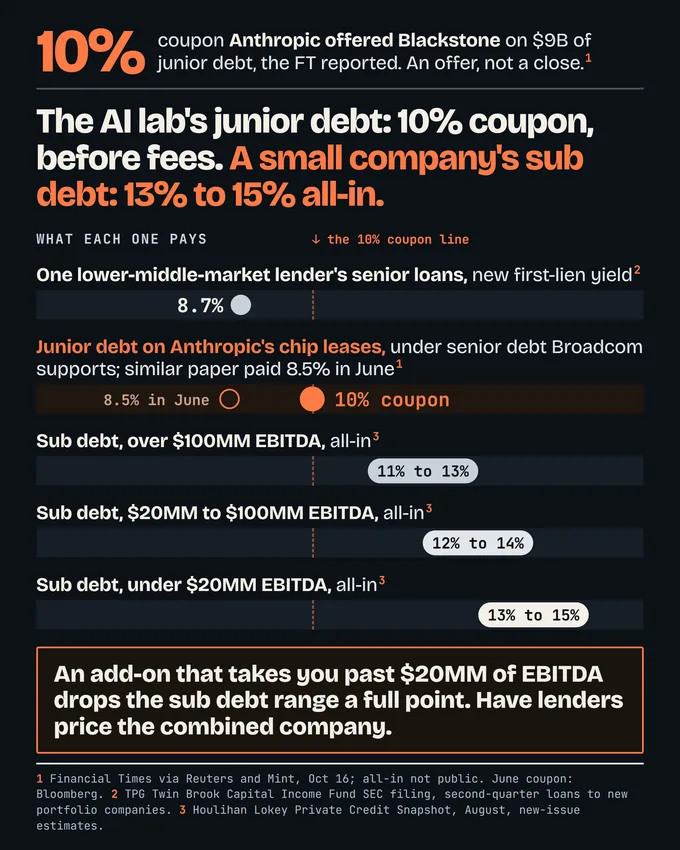
Source: see Sources below. As of October 2026.
| Figure | What it shows |
|---|---|
| 10% | Coupon offered on $9BN of Anthropic junior debt |
| 8.7% | New first lien yield at one lower middle market lender |
| 11% to 13% | Sub debt all-in, over $100MM of EBITDA |
| 12% to 14% | Sub debt all-in, $20MM to $100MM of EBITDA |
| 13% to 15% | Sub debt all-in, under $20MM of EBITDA |
The coverage read it as AI paying up, and it is. The FT says borrowers rated like Anthropic pay about 7% on public bonds, and similar junior paper in June carried an 8.5% coupon.
Next to private sub debt, a 10% coupon is below every Houlihan range, including 11% to 13% all-in above $100MM of EBITDA. The all-in on the chip notes isn't public, but discounts and fees would have to add at least a point a year to reach even that range.
TPG Twin Brook's lower-middle-market lending fund underwrote first-lien loans to new portfolio companies at an average 8.7% yield in the second quarter.
My read: the AI print isn't your benchmark. Your size is.
Small companies default more: Fitch's trailing 12-month private credit default rate as of August was 12.0% for issuers under $25MM of EBITDA, against 5.2% for $26MM to $50MM.
Smaller LBOs carry less leverage, too: KBRA DLD had lower-middle-market LBO leverage at 3.7x in July, against 5.1x for upper-middle-market and large-cap deals.
For a $2MM-$15MM EBITDA deal, junior debt stays the expensive debt layer of your stack, whatever AI credit does.
Houlihan's sub debt ranges step down a full point above $20MM of EBITDA. On a roll-up that reaches $25MM of EBITDA with one turn of sub debt, a point off the coupon is $250K a year of interest. Before a roll-up model counts on it, get junior debt quotes for the combined company, not just the add-on.
The fair pushback: different instruments. The junior notes sit under senior debt that Broadcom supports, the terms are an offer, not a close, and the FT says the other $9B may price lower. That's the point. Lenders price the borrower and the structure, not the word "junior."
What is junior debt costing on your sub-$20MM EBITDA deals?
The research behind this
- Reuters, Anthropic offers Blackstone double-digit yield in chip financing deal, FT reports, October 17, 2026.
- Houlihan Lokey, U.S. private credit market newsletter, summer 2026, 2026.
- TPG Twin Brook Capital Income Fund, SEC filing, September 15, 2026.
- Fitch Ratings, U.S. private credit default rate rose to 6.3% in August 2026, September 14, 2026.