Marks vs. Prices, Private credit and lending
Industrial borrowers default at 9.9% in private credit while software sits at 0.6%
By Jeff Baehr, Founder & CEO, Praxis Rock Advisors
In brief
In Fitch's trailing 12-month private credit default rates through August, industrial and manufacturing borrowers nearly doubled to 9.9% while software sat at 0.6%. Most counted defaults are PIK switches, deferrals and stressed extensions, and a PIK option written at origination is not a default. For buyers of manufacturers, a PIK toggle is worth pricing at close.
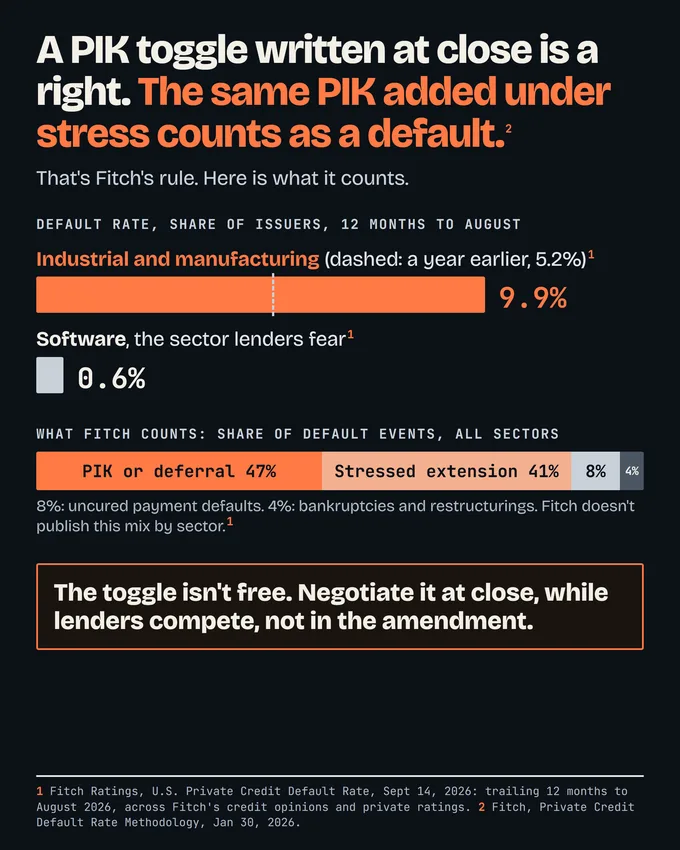
Fitch has industrial and manufacturing borrowers defaulting at 9.9% in private credit.
Software, the one lenders fear, sits at 0.6%.
Those are Fitch's trailing 12-month private credit default rates through August, across its credit opinions behind middle-market CLO ratings plus the private ratings insurers use. Industrial and manufacturing nearly doubled from 5.2% a year earlier, and healthcare providers tie it at 9.9%. Across sectors, borrowers under $25MM of EBITDA default at 12.0%.
Source: see Sources below. As of October 2026.
| Figure | What it shows |
|---|---|
| 9.9% | Industrial and manufacturing default rate, 12 months to August |
| 5.2% | The same rate a year earlier |
| 0.6% | Software default rate |
| 47% | Default events that were PIK switches or deferrals |
| 41% | Default events that were stressed extensions |
| 8% | Uncured payment defaults |
Lenders are steering by the software fear. Saratoga, a lower-middle-market BDC, says "the hurdle is very high to do new software deals," and neither of the two platforms it closed in its latest quarter is in software. Sikich says competition for attractive non-software and lower-middle-market deals is intense, and spreads have tightened.
My read: software's test is still ahead, at refinancing. In May, Fitch's syndicated loan analysts put software at 33% of their Top Loans of Concern, issuers most likely to default within 24 months. That's a watchlist, a fair worry about what comes next. The industrial 9.9% is defaults already counted.
And most of what Fitch counts isn't a missed payment. Across sectors, PIK switches and interest deferrals are 47% of its default events, and maturity extensions under stress 41%. Uncured payment defaults are 8%. Mostly, it's a lender buying time: amendments, not bankruptcies.
A PIK switch isn't a realized loss, either. Fitch counts one only when the lender accepts materially reduced terms and the change lets the borrower avoid bankruptcy, similar proceedings or a payment default.
Here's the structuring catch. Fitch calls a PIK option written at origination a contractual right, not materially reduced terms. Written in at close, it isn't a default.
So tight pricing on an industrial deal tells you lenders want the deal, not that the sector is clean. The same Sikich note puts performance concerns in lower-middle-market and software portfolios.
For a team buying $2MM-$15MM EBITDA manufacturers, that makes a PIK toggle worth pricing at close, while lenders compete. It isn't free, and it doesn't fix the credit. But it's a right you hold, not a concession you ask for in the amendment.
Industrial buyers: is your lender pricing your sector, or the competition for your deal?
The research behind this
- Fitch Ratings, U.S. private credit default rate rose to 6.3% in August 2026, September 14, 2026.
- Fitch Ratings, Software maturity wall poses challenge for U.S. BSL CLOs, May 12, 2026.
- Sikich, Q3 2026 credit market update, October 2026.