Marks vs. Prices, Technology and the capital cycle
Meta's Hyperion guarantee: a $46BN disclosed worst case, recorded at zero
By Jeff Baehr, Founder & CEO, Praxis Rock Advisors
In brief
Beignet Investor sold $27.3BN of bonds for the Blue Owl side of Meta's Hyperion data center campus, while committed rent runs four years from 2029. Meta's residual value guarantee is capped near $28BN and carried at zero. Above the cap and after year sixteen, losses fall first on the venture's owners, where the funds hold 80%.
Last October, a company you have never heard of sold $27.3 billion of bonds in a single deal.
Beignet Investor sold them for the Blue Owl Capital side of Hyperion, the Louisiana data center campus Meta is building. The venture split: Blue Owl funds 80%, Meta 20%.
Meta is the tenant. Committed rent runs four years from 2029, a $12.3 billion initial commitment, less than half the bond, which runs to May 2049.
The bridge is a residual value guarantee. If Meta walks and the campus is not worth its number, Meta writes a check, capped near $28 billion. S&P rated the paper A+ because of it: the contract passes "substantial credit risk to Meta." Meta's books carry the guarantee at zero; payment is judged "not probable."
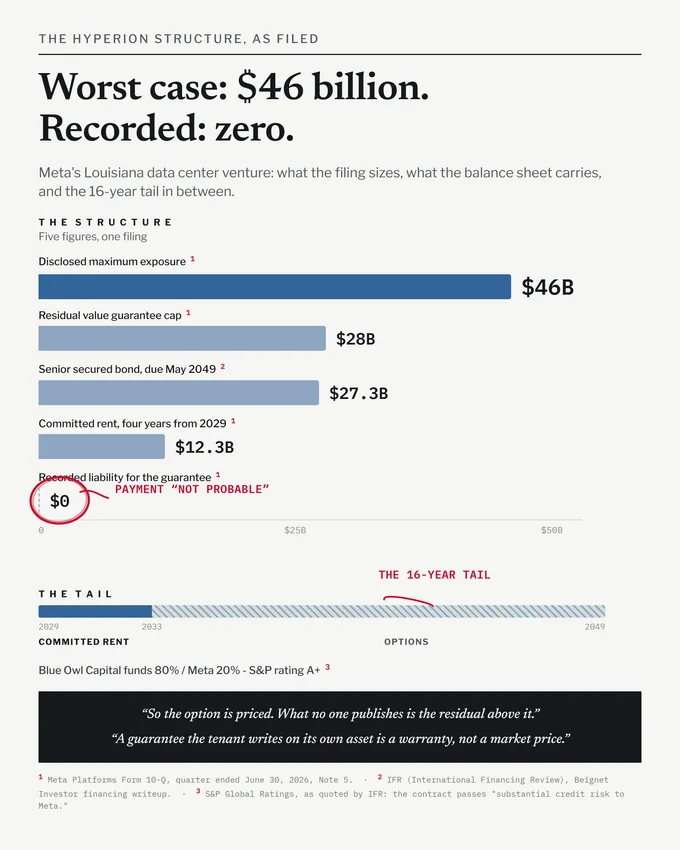
Source: see Sources below. As of August 2026.
| Figure | What it shows |
|---|---|
| $46BN | Disclosed maximum exposure |
| $28BN | Residual value guarantee cap |
| $27.3BN | Senior secured bond, due May 2049 |
| $12.3BN | Committed rent, four years from 2029 |
| $0 | Recorded liability for the guarantee |
| 80% / 20% | Funds and Meta shares of the venture |
The point: nobody knows more about what an AI campus will be worth in 2033 than the company building this one. Part of it is capacity; even these balance sheets have limits.
But capacity explains the borrowing, not the shape: ownership handed to funds, rent committed for four years with options, a hedge written against the asset's own value. Templates exist; someone still chose these terms. You only pay for options you think you might use.
So the option is priced. What no one publishes is the residual above it.
The residual is the car-lease question: what is the thing worth when the lease ends. Run 2033 forward.
Meta renews and nobody thinks about it again. Meta walks but the campus holds its value; the funds re-let it. Meta walks because a 2029 building and its power contracts are not worth their number, and Meta pays the shortfall, up to a cap that steps down through year sixteen.
Above the cap, and after year sixteen, the loss belongs first to the venture's owners. Eighty percent of that is the funds.
Every argument about AI demand ends at that number: what a used AI campus fetches. For now it is a mark no one has to test. Meta disclosed a worst case near $46 billion. The recorded number is zero. A sixteen-year tail sits between the rent and the bond; no line item prices it.
The Wall Street Journal counted about $3 trillion of off-balance-sheet commitments at nine tech companies. The BIS named the pattern in March: shadow borrowing, held by private credit funds and institutional investors. The same institutions most GPs call LPs.
Two concessions. None of this is hidden; the SEC has required the disclosure since 2003. And the paper is not junk: secured, amortizing, investment grade. The buyers took a spread to own it.
My read: price the structure, not the story, the way you price founder secondary. The pitch on AI is decades of demand; the commitment is four years. A guarantee the tenant writes on its own asset is a warranty, not a market price.
The closest precedent is 1970s mainframe leasing: the next product cycle set the residuals for everyone. The funds' answer: the collateral is not the machine but the powered site.
Both can be right at different prices. 2033 sets them. No balance sheet hands you the answer early.
The research behind this
- The Wall Street Journal, Why Big Tech's spending is $3 trillion higher than it seems, August 16, 2026.
- Meta Platforms, Form 10-Q, quarter ended June 30, 2026 (Note 5), July 2026.
- IFR, Financing package: Blue Owl Capital and Beignet Investor $27.3BN bond, 2026.
- Bank for International Settlements, BIS Quarterly Review, March 2026, March 2026.