Marks vs. Prices, LPs, returns and liquidity
The exit window is open for durable assets, not for 2021 software held at 2021 marks
By Jeff Baehr, Founder & CEO, Praxis Rock Advisors
In brief
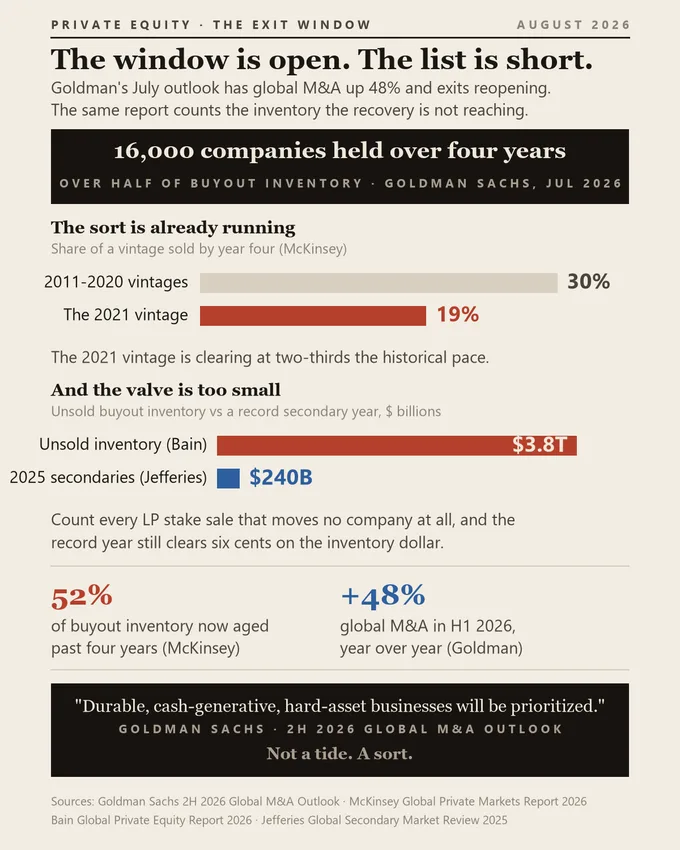
Goldman's July outlook has global M&A up 48% in the first half, yet roughly 16,000 buyout companies have been held more than four years. The 2021 vintage has sold 19% of its investments by year four, against 30% historically. Buyers are sorting assets, and waiting does not move a manager up the queue.
Goldman says the exit window is opening. The same report tells you who it opens for.
Goldman's July M&A outlook is the headline private equity waited four years for. Global M&A up 48% in the first half. Separations running 145% above the recent average. SpaceX's $85.7B IPO reopening the public exit.
The coverage read: liquidity is back, wait it out, the tide is coming in.
Keep reading the same document.
Source: see Sources below. As of August 2026.
| Figure | What it shows |
|---|---|
| 16,000 | Buyout companies held over four years |
| 30% vs 19% | Share of a vintage sold by year four: 2011 to 2020 vintages against the 2021 vintage |
| $3.8TN | Unsold buyout inventory |
| $240BN | 2025 secondary volume |
| 52% | Share of buyout inventory aged past four years |
| +48% | Global M&A, first half of 2026, year over year |
Goldman counts the inventory: roughly 16,000 buyout companies held more than four years. More than half of every company buyout funds own. Distributions near lows unseen since the financial crisis.
McKinsey's count: 52%, the highest share on record.
Goldman's own words: durable, cash-generative, hard-asset businesses will be prioritized, while assets most exposed to disruption could face greater valuation pressures.
That is not a tide. That is a sort.
A sort is not a malfunction. Sorting durable cash flow from impaired assets is what markets do. The problem is that half the inventory is still marked as though the sort will not reach it.
KPMG has PE exit value from company sales on pace for a decade high while exit count is on pace for a decade low. Sales, not listings.
GPs historically sold 30% of investments by year four, per McKinsey. The 2021 vintage got to 19%. Bain counts 32,000 unsold companies worth $3.8 trillion.
Secondaries cannot absorb the difference. Jefferies put last year's record secondary volume at $240 billion against Bain's $3.8 trillion of unsold inventory. Count every LP stake sale that moves no company at all, and it is six cents on the inventory dollar.
The window is real, and it is selective.
Buyers are underwriting AI exposure asset by asset. What AI needs gets bid: durable cash flows, hard assets. What AI competes with gets a question instead, and software bought at 2021 multiples has to answer it.
Bain says what still clears at high prices is mostly top-tier assets. My read on why: selling below the mark is the most expensive thing a GP can do mid-fundraise.
Managers holding durable businesses are getting that market now. Managers holding 2021 software at 2021 marks are not in the queue. They are the inventory.
Waiting is the one strategy the sort does not reward. What a buyer will pay for a 2021 asset is knowable this quarter. Whether a manager wants to know is the decision.
The research behind this
- Goldman Sachs, 2H 2026 Global M&A Outlook, July 22, 2026.
- McKinsey & Company, Global Private Markets Report 2026, 2026.
- Bain & Company, Global Private Equity Report 2026 (press release), 2026.
- KPMG, Pulse of Private Equity, H1 2026, July 2026.
- Jefferies, 2025 Global Secondary Market Review, 2026.