Marks vs. Prices, Technology and the capital cycle
Split a contractor's data center backlog by who pays for the build
By Jeff Baehr, Founder & CEO, Praxis Rock Advisors
In brief
Meta's third quarter capex ran $2.12BN past its operating cash flow, but it holds $82.45BN of cash and securities, while CoreWeave's unsecured debt yields about 15%. Both can sit in the backlog of a lower middle market contractor. Orders funded with high yield debt belong on their own line, at a lower multiple.
Meta just ran $2.12B of negative free cash flow. CoreWeave's unsecured debt yields about 15%.
Only one is on a clock, and it isn't Meta. Both can sit in the data-center backlog of the LMM contractor you're buying.
The seller's banker will pitch that backlog as one number. The lender will ask who pays for the build.
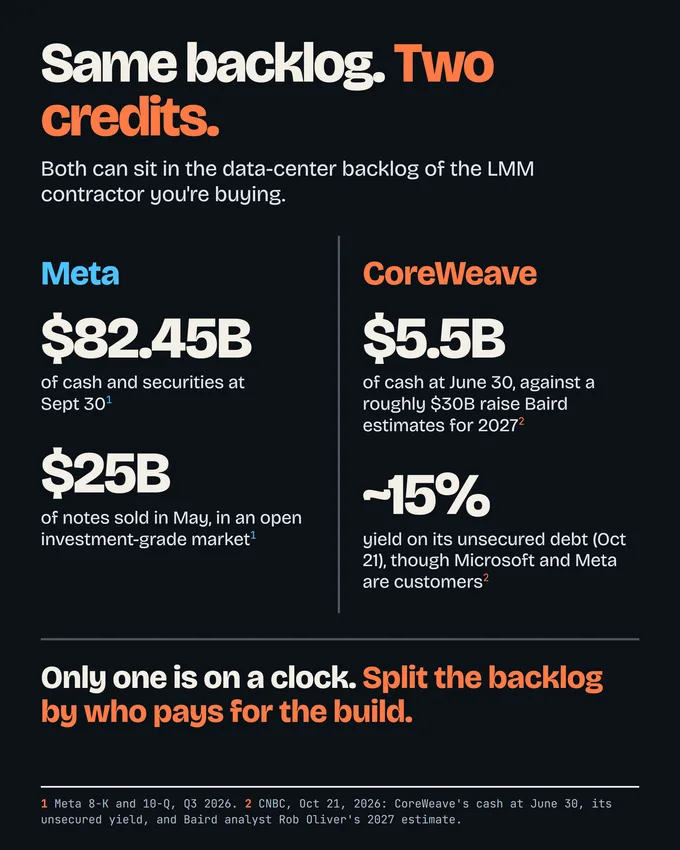
Source: see Sources below. As of October 2026.
| Figure | What it shows |
|---|---|
| $82.45BN | Meta cash and securities at Sept. 30 |
| $25BN | Notes Meta sold in May |
| $5.5BN | CoreWeave cash at June 30 |
| $30BN | CoreWeave raise estimated for 2027 |
| 15% | Yield on CoreWeave unsecured debt |
Meta's third-quarter gap was $34.91B of capex, counting finance-lease principal, against $32.79B of operating cash flow. It sits on $82.45B of cash and securities and sold $25B of notes in May.
Blackstone's Jas Khaira, who downplays AI debt fears, prices risk to the customer: when it's investment grade, Microsoft or Meta, "the risk gets priced relative to that customer." That still leaves the borrower's own debt to price.
Forbes counts $37B of this year's $80B of data-center bonds as junk, some of it on projects leased to or backed by Amazon, Meta or Oracle. Unnamed credit desks told CNBC the high-yield debt market is effectively on hold until after the midterms.
In ABC's September survey, contractors with data-center work averaged 11.3 months of backlog, three months more than those without, and only about 1 in 10 under $100MM of revenue has that work.
My read: in a lower-middle-market deal, data-center backlog isn't one number. Split it by who pays for the build. An order Meta or Microsoft pays for from its own balance sheet rides cash and an open investment-grade market.
An order paid from a developer's or neocloud's own debt can land in high yield, on hold for now, even with a hyperscaler as the tenant. Price the high-yield-funded orders as a second revenue stream, and don't let them carry the same multiple.
CoreWeave shows the split. Its customers include Microsoft and Meta, but its unsecured debt sits behind its GPU-backed loans, and it had $5.5B of cash at June 30 against a roughly $30B raise Baird estimates for 2027.
Fair objections: most data centers are built for hyperscalers, as Khaira says, and the hold may be a timing pause, not a stop. And a subcontractor is paid by the general contractor, but most states enforce a clear pay-if-paid clause that passes an owner's nonpayment down. Read the subcontract.
Specialty contractor buyers: are you haircutting the high-yield-funded backlog in IC, or still underwriting to the tenant's logo?
The research behind this
- Meta Platforms, Third quarter 2026 results, Form 8-K exhibit 99.1, October 2026.
- Meta Platforms, Form 10-Q, quarter ended Sept. 30, 2026, October 2026.
- CNBC, CoreWeave's market confidence erodes as bond yields spike, October 21, 2026.
- TechCrunch, Blackstone's Jas Khaira says fears over buildout debt are overblown, October 21, 2026.
- Forbes, Why debt-laden neoclouds could become a trillion-dollar WeWork, October 16, 2026.
- ABC, ABC's Construction Backlog Indicator rises again in September on data center strength, October 2026.