Marks vs. Prices, LPs, returns and liquidity
In a continuation vehicle the GP buys and most LPs sell, at the same price
By Jeff Baehr, Founder & CEO, Praxis Rock Advisors
In brief
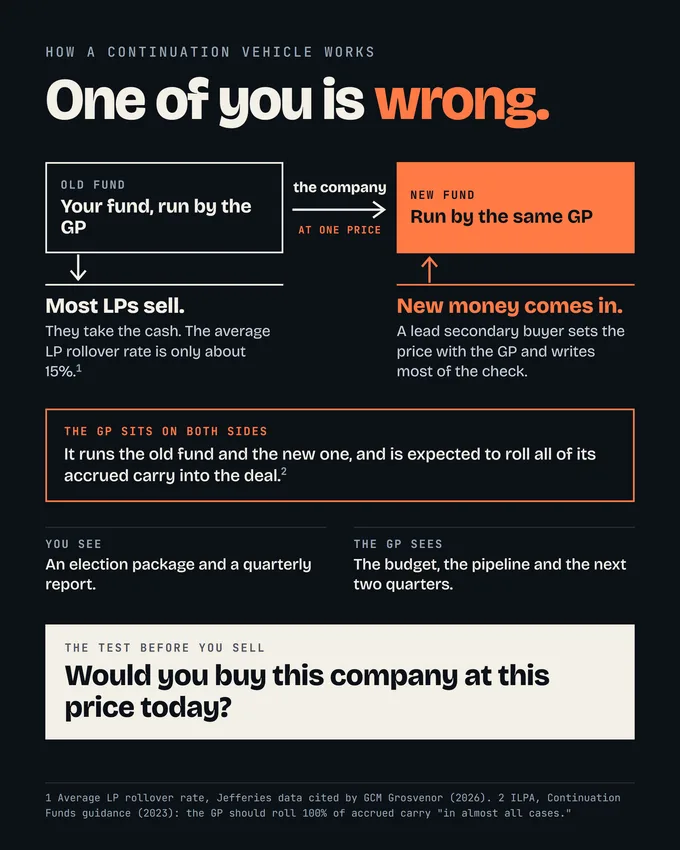
GP-led deals, mostly continuation vehicles, reached $115BN last year, and the average LP rolls only about 15%. The GP is expected to roll its accrued carry, so the investor closest to the company buys while the investors furthest from it sell. Before an election deadline, ask whether you would buy the company at this price today.
Your GP is rolling into the company you're selling, at the same price. One of you is wrong.
That's a continuation vehicle. The GP moves a company from an old fund into a new one it also runs, and the old fund's LPs choose: take cash at the deal price, or roll into the new fund.
These are no longer a niche trade. GP-led deals, mostly continuation vehicles, hit $115 billion last year, by Jefferies' count. Energy Capital Partners said on Oct. 5 it closed an $834 million one for Next Wave and would reinvest its own proceeds.
The LPs mostly sell. Jefferies puts the average LP rollover at about 15%. The GP is expected to stay in: ILPA's guidance asks GPs to roll 100% of their accrued carry in almost all cases.
Source: see Sources below. As of October 2026.
| Figure | What it shows |
|---|---|
| 15% | Average LP rollover rate |
| 100% | Share of accrued carry the GP is asked to roll, in almost all cases |
| $115BN | GP-led deal volume last year, mostly continuation vehicles |
So the investor closest to the company buys, and the investors furthest from it sell. The GP has the budget, the pipeline and the next two quarters. The LP has an election package and a quarterly report.
In my experience, most LPs who sell aren't betting against the GP. They need distributions. And rolling usually isn't standing still. In Houlihan Lokey's study of 2023-24 deals, only 17% offered a true status-quo option, and 63% required rolling LPs to top up their commitment.
Maybe neither of you is wrong. Selling for cash isn't a view on the company. It's a view on your own portfolio.
The GP and a lead buyer set the price, usually off a NAV that is already months old, and offer it to investors whose real constraint is their DPI, the cash their funds have actually paid back.
None of that makes the GP right. A continuation vehicle is a bet with the GP's own money in it, on a fresh fee and carry package, and bets lose.
Most of the money comes from secondary investors that typically run their own diligence, like ECP's anchors GCM Grosvenor, Ardian and StepStone. The selling LP gets cash today in a market short on exits.
So before the next election deadline, ask two questions. How much new money is the GP putting in? And would you buy this company at this price today?
If the second answer is yes and you're selling anyway, that's your DPI talking.
The research behind this
- Jefferies, 2025 Global Secondary Market Review, 2026.
- Latham & Watkins, ECP continuation vehicle for Next Wave Energy Partners, October 2026.
- GCM Grosvenor, The GP-led continuation vehicle market, May 18, 2026.
- ILPA, Continuation Funds: Considerations for Limited Partners and General Partners, May 2023.
- Houlihan Lokey, 2024 Continuation Fund Study, 2025.
- Mayer Brown, Building a defensible process: GP-led continuation fund transactions in 2026, July 2026.