Marks vs. Prices, LPs, returns and liquidity
2025 buyouts paid the 2021 record price, with more equity and the same return math
By Jeff Baehr, Founder & CEO, Praxis Rock Advisors
In brief
The median US buyout in 2025 cleared at 12.5x EBITDA, tying the 2021 record. Sponsors now write half or more of the purchase price, up from about 35%, so a bad deal shows up as a weak return rather than a covenant breach. The price, which the return is computed against, has not come down.
Private equity didn't learn from 2021. It just changed how it pays.
The consensus story is cheap debt: money was free, sponsors overpaid, rates normalized, discipline came back. So check the price.
The median US buyout in 2025 cleared at 12.5x EBITDA, tying the 2021 record. StepStone's deal data puts the ones over a billion dollars at 16x and the ones under at 10.8x, so the headline is a large-cap number. McKinsey counts differently and still calls 2025 a record.
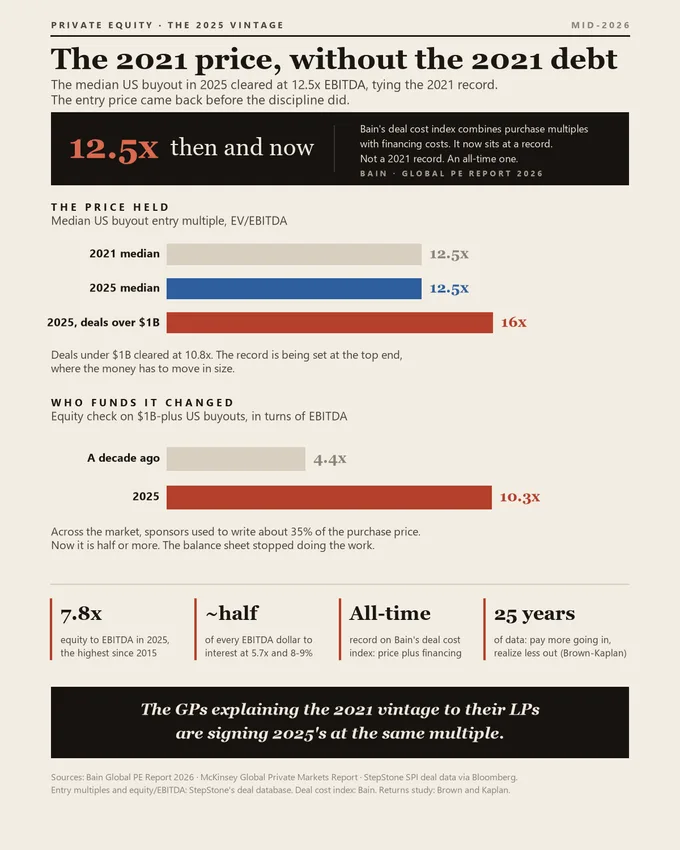
Source: see Sources below. As of July 2026.
| Figure | What it shows |
|---|---|
| 12.5x | Median US buyout entry multiple, 2021 and 2025 |
| 16x | 2025 deals over $1B |
| 10.8x | 2025 deals under $1B |
| 4.4x to 10.3x | Equity check on $1B-plus buyouts, a decade ago and 2025, in turns of EBITDA |
| 7.8x | Equity to EBITDA in 2025, the highest since 2015 |
What moved is who funds it. Equity ran 7.8x EBITDA last year, the highest since 2015. On those deals the equity check went from 4.4 turns of EBITDA to 10.3 in a decade. Sponsors used to write about 35% of the purchase price. Now half or more.
That's a real change and it moves the failure mode. At this much equity a bad deal is a bad IRR, not a covenant breach and a forced sale. What it doesn't move is the price, and the price is what the return gets computed against.
The other fair objection is that quality is scarce, so this money is buying better companies. McKinsey says exactly that, and puts deployment pressure in the same sentence. Both are true. Scarcity explains why the price is defensible. It doesn't make the return arrive.
Because Bain's deal cost index, combining purchase multiples with financing costs, sits at a record. Not a 2021 record. An all-time one.
Run the interest. At 5.7 turns of debt and 8 to 9% money, roughly half of every EBITDA dollar on a billion-dollar deal goes to lenders before equity sees anything. Smaller deals carry 4 turns, so call it a third. The burden isn't unprecedented. Carrying it at a record price is.
There's evidence, not just pattern matching. Brown and Kaplan ran entry multiples against buyout fund returns across twenty-five years. Negative and significant. Pay more going in, realize less coming out. The same paper notes good managers beat the S&P anyway. Both findings are in it.
My sense is 2025 and 2026 get written up the same way, and the write-up lands around 2031.
The GPs explaining the 2021 vintage to their LPs this year are signing 2025's at the same multiple. There's an answer that works: you bought something that actually compounds at twelve, or you bought off the median. Neither is the median deal. Which one is yours?
The research behind this
- Yahoo Finance, Multiples on US buyout deals matched record (StepStone deal data), July 2026.
- Bain & Company, Global Private Equity Report 2026, 2026.
- McKinsey & Company, Global Private Markets Report 2026, 2026.
- Brown and Kaplan, Have Private Equity Returns Really Declined?, May 2019.